

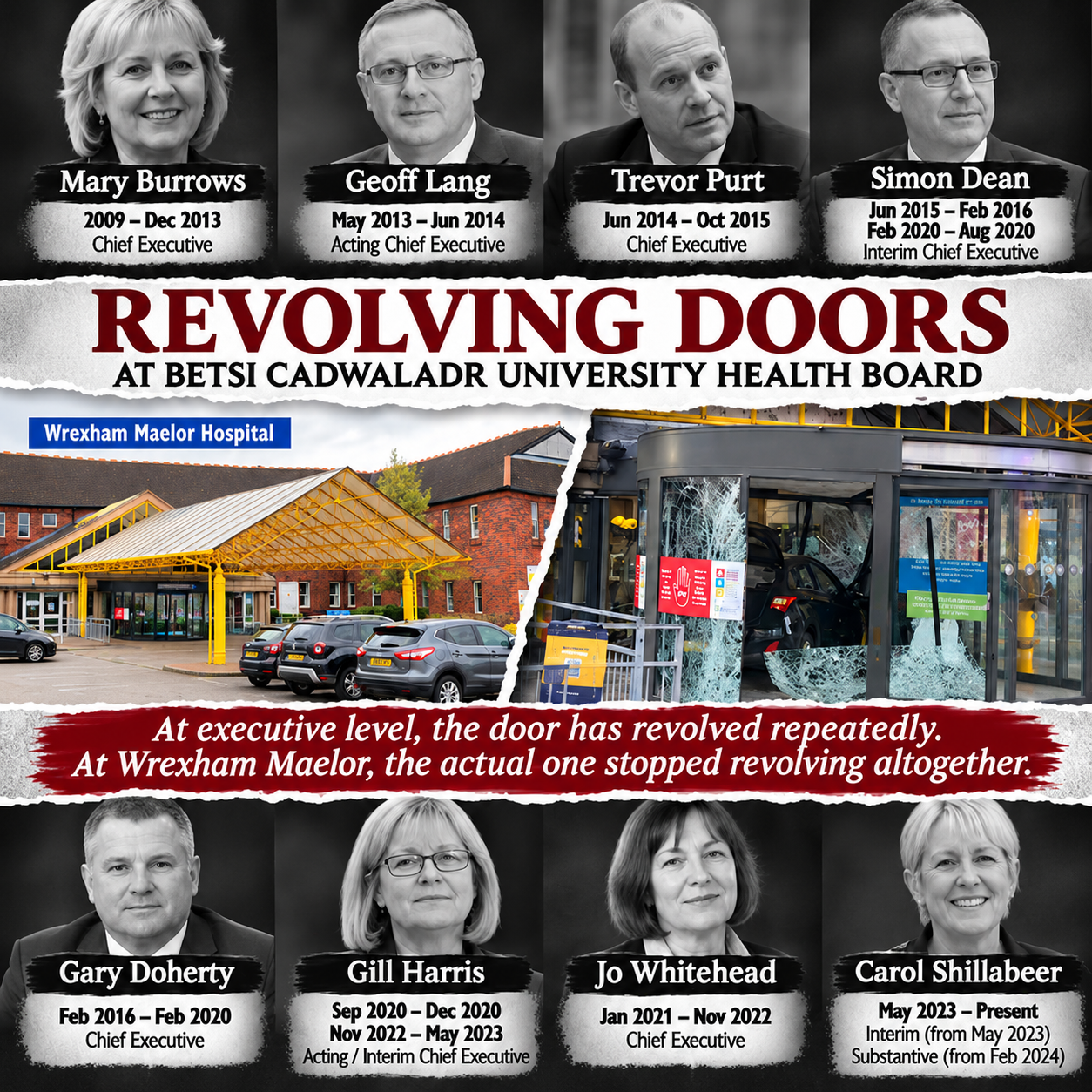
When the metaphor becomes inconveniently literal.
The phrase “revolving door at the top” has already been used in the Senedd to describe leadership turnover at Betsi Cadwaladr University Health Board.
During the Senedd debate on 30 June 2026, Natasha Asghar MS argued that the answer to Betsi’s problems did not simply lie in appointing another chief executive:
“In 11 years, it’s been a revolving door at the top.” [1]
The metaphor is particularly unfortunate.
At Wrexham Maelor Hospital, the actual revolving entrance doors were damaged when a car crashed into them on 6 December 2023. [2]
The replacement process proved somewhat less rapid than the collision.
Planning application P/2024/1671 proposed demolishing the damaged revolving entrance and side entrance and replacing them with a sliding-door entrance. The application was approved on 30 January 2025. [4]
By June 2026, Wrexham MP Andrew Ranger said the main door had been out of use for around 18 months. He said progress had been delayed partly by an insurance funding gap, although replacement work was then expected to be completed by the end of the year. [3]
Then, on 11 November 2026, Carrie Harper MS raised the entrance in the Senedd itself, saying that Wrexham Maelor had been without its front door for around three years since it was damaged by a car. [20]
Approaching three years later, the entrance had therefore acquired its own remarkably lengthy administrative history.
Perhaps there is an unintended efficiency lesson here.
If revolving doors have proved troublesome both literally and metaphorically, would sliding doors at least allow a faster departure?
At executive level, the door has revolved repeatedly.
At Wrexham Maelor, the actual one stopped revolving altogether.
Who has actually been through the executive door?
Different reports over the years have produced slightly different totals for the number of chief executives at Betsi Cadwaladr.
That is partly because the answer depends on what is being counted.
Do we count individual people?
Separate periods in office?
Acting appointments?
Interim appointments?
Or only substantive chief executives?
Rather than inherit somebody else’s arithmetic, it is easier to lay out the chronology.
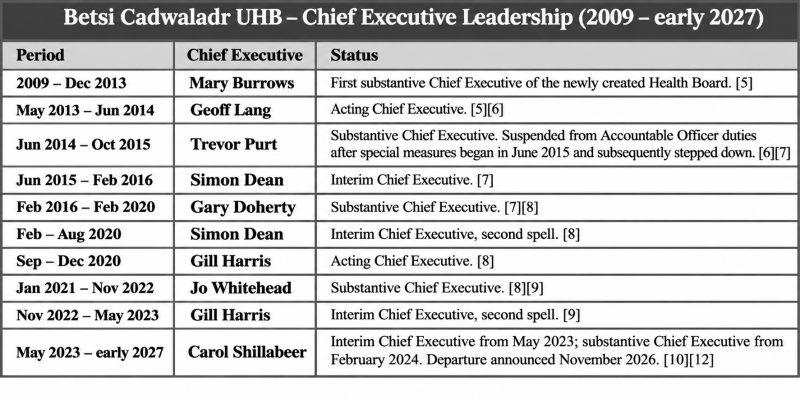
The early years involved some overlap between acting and substantive arrangements. Later records also contain minor discrepancies over individual handover dates.
For example, Betsi’s 2022/23 Annual Report says in one section that Jo Whitehead retired on 16 November and Gill Harris became Interim Chief Executive from that date, while its remuneration notes record Whitehead in post until 15 November and Harris taking over from 16 November. [9]
Rather than perform forensic archaeology over twenty-four hours of NHS management history, the table therefore uses month and year.
The overall picture remains clear.
Eight different people have held the Chief Executive role since Betsi Cadwaladr was created.
Simon Dean and Gill Harris each did it twice.
That produces ten separate periods of substantive, acting or interim chief-executive leadership.
Because apparently even counting the revolving door requires explanatory notes.
And now another departure
In a statement dated 13 November 2026, Betsi Cadwaladr announced that Carol Shillabeer will leave the organisation early in the new year after being appointed Chief Executive of Lancashire and South Cumbria NHS Foundation Trust.
The Health Board said she would remain engaged in her Betsi role until the move and that interim and longer-term leadership arrangements would be announced in due course. [12]
There is nothing inherently remarkable about a chief executive moving to another NHS organisation.
Senior executives change jobs.
People retire.
People are promoted.
People decide that three and a half years inside one of the most scrutinised health organisations in Wales is probably sufficient exposure to character-building opportunities.
The significance is the context.
Shillabeer arrived as Interim Chief Executive on 3 May 2023, shortly after Betsi Cadwaladr had returned to Level 5 special measures, the highest level within the NHS Wales escalation framework. [10][13]
In November 2023, announcing that she had secured the substantive position, the Health Board specifically said the appointment would provide “continuity of leadership” and support the work required to bring Betsi out of special measures. [11]
The Board’s register records her interim appointment ending on 31 January 2024 and her substantive Chief Executive appointment beginning on 1 February. [10]
Nearly three years after her arrival, Betsi remains in Level 5 special measures.
And another leadership transition is coming.
That does not mean Carol Shillabeer failed.
Nor does it mean her departure caused the Health Board’s longstanding problems.
Many of those problems existed long before she arrived.
Welsh Government’s March 2026 progress report also recorded genuine improvement, including stronger governance arrangements, leadership reforms, quality and safety systems, financial controls and corporate assurance. [14]
But the same report recorded significant and persistent problems, particularly in cancer, planned care and urgent and emergency care. [14]
So another question becomes increasingly difficult to avoid:
How much organisational stability can realistically be created when leadership stability itself repeatedly has to be recreated?
Still under special measures
Betsi Cadwaladr returned to Level 5 special measures on 27 February 2023 because of serious concerns involving Board effectiveness, organisational culture, service quality and reconfiguration, governance, patient safety, operational delivery, leadership and financial management. [13]
Level 5 is the highest level within the NHS Wales escalation framework.
It is intended for organisations with serious problems where there are concerns that the organisation cannot make the necessary improvements without external support. [13]
By March 2026, Welsh Government acknowledged progress but said significant and persistent challenges remained. [14]
Then, on 30 June 2026, the approach changed again.
Welsh Government said previous arrangements had relied upon the Health Board leading its own recovery with external support.
According to Welsh Government:
“That has not delivered the pace or scale of change required.” [15]
A more directly led intervention followed.
It included a full stocktake and an independent Well-Led Review examining patient safety, leadership, governance, organisational culture and Board capability. [15]
During the Senedd debate the same day, the Minister described a stronger intervention, with independent challenge and closer oversight of those responsible for delivering improvement. [1]
Which makes the timing of the latest executive departure difficult to ignore.
The Chief Executive is preparing to leave at almost exactly the moment an independent review specifically examining leadership, governance, culture and Board capability is preparing to report.
Nobody arranged the symbolism.
Apparently it was unnecessary.
Open season for scrutiny
At this point, keeping track of who is reviewing which part of Betsi Cadwaladr requires almost as much organisation as running the place.
The Health Board remains in special measures. [13]
Welsh Government has commissioned the independent Well-Led Review. [15]
Healthcare Inspectorate Wales continues inspection and enhanced monitoring activity.
Following an unannounced inspection in May 2026, HIW designated the Emergency Department at Ysbyty Glan Clwyd a Service Requiring Significant Improvement, citing concerns about leadership, governance and risk management. [16]
Audit Wales published a follow-up review of quality governance in July 2026.
It found that Betsi was taking steps to strengthen its arrangements, but weaknesses remained. Audit Wales identified the need for clearer quality priorities, stronger leadership and accountability, and improvements in areas including quality leadership, staff training, reporting and demonstrating that lessons had been learned. [17]
Betsi’s own statements page currently says:
“We are contributing to a number of independent reviews arranged by Welsh Government.” [18]
So perhaps “open season for investigations” is technically unfair.
Some are investigations.
Some are inspections.
Some are reviews.
Some are interventions.
Some are monitoring arrangements.
Some examine governance.
Some examine particular clinical services.
And some review areas that have previously been reviewed.
The NHS remains reassuringly capable of maintaining taxonomic diversity even during a crisis.
But the cumulative point matters.
Betsi Cadwaladr is not suffering from a shortage of scrutiny.
The real test is therefore not whether another review can identify another problem.
It is whether all that scrutiny produces sustained organisational change.
A warning from across the border
There is also a wider NHS leadership question here, although it needs an important qualification.
The 2026 Thirlwall Inquiry concerned the Countess of Chester Hospital and the NHS in England.
It did not investigate Betsi Cadwaladr.
It did not investigate NHS Wales.
Its findings therefore cannot simply be transplanted across the border and applied to either.
But Chapter 37 of its final report examined the training, regulation and accountability of NHS managers and recorded something relevant to the broader discussion about leadership turnover.
The Inquiry heard evidence that the Chief Executive role carried a high risk of failure and that blaming the Chief Executive could become an easy response.
It also heard evidence about failing managers being moved, with NHS England assistance, into alternative posts through a process one witness said was informally known as:
“the donkey sanctuary”. [19]
The report expressed concern about senior managers moving into new roles without the reasons for previous failure necessarily being addressed. [19]
Again:
That evidence relates to NHS England.
It is not evidence that such a system operates at Betsi Cadwaladr or within NHS Wales.
But it raises a useful broader question.
If organisational problems persist across multiple changes of leadership, continually changing the person at the top eventually becomes less interesting than examining the system surrounding that individual.
Which brings us back to Betsi.
The Well-Led Review arrives at an awkward moment
On 11 November, Carrie Harper MS questioned the Health Minister about Betsi’s leadership arrangements.
She also mentioned something rather familiar by now:
Wrexham Maelor’s missing front door. [20]
Health and Care Minister Mabon ap Gwynfor responded by drawing an important distinction between the clinical care being provided in many services and the organisational concerns surrounding it.
He said:
“We have a problem with governance and with leadership and culture.” [20]
He confirmed that the independent Well-Led Review was expected to be published imminently and that he would make a statement in the Senedd on 24 November, based on the review, after which decisions would be made about the next steps for Betsi Cadwaladr. [20]
The Senedd’s formal business programme now lists a 45-minute statement for that date titled:
“Update on Level 5 intervention and Welsh Government response to the Betsi Cadwaladr UHB Independent well-led review.” [21]
So as 24 November approaches, the organisation finds itself in a particularly interesting position.
It remains at the highest level of NHS escalation.
An independent review of leadership, governance and culture is about to report.
Its Chief Executive has announced she is leaving.
And the Board must now consider both interim and longer-term leadership arrangements.
For an organisation repeatedly told that it requires leadership stability, the timing could hardly be more conspicuous.
But accountability cannot stop at the Chief Executive’s door
Chief executives matter.
They set expectations.
They influence culture.
They lead executive teams.
They are accountable for enormous organisations spending very large sums of public money and delivering services upon which lives depend.
So leadership absolutely deserves scrutiny.
But after this many changes at the top, accountability cannot sensibly be reduced to a succession of individual chief executives.
Betsi Cadwaladr has had different chief executives.
Different Chairs.
Different Board members.
Different Ministers responsible for health.
Different intervention frameworks.
Different improvement plans.
Different external advisers.
And different reviews.
Yet leadership, governance, accountability and organisational culture continue to appear in official assessments. [13][14][15][17]
Eventually, therefore, the question has to travel further up the chain.
If a chief executive does not deliver the required change, the Board must ask why.
If the Board cannot secure sustainable improvement, the oversight system must ask why.
And if an organisation remains for years at the highest level of escalation while leadership repeatedly changes, Welsh Government must be able to demonstrate not merely that it has intervened, but that the intervention model itself is capable of producing lasting improvement.
That is not an argument for blaming everybody.
It is an argument against allowing accountability to stop conveniently with whoever happens to occupy the Chief Executive’s office when the latest review lands.
Because there is always another person who can walk through that door.
There can always be another interim appointment.
Another recruitment process.
Another fresh start.
Another improvement plan.
Another promise of stability.
The harder question is whether the organisation around them changes too.
Betsi Cadwaladr’s revolving door at executive level has already turned through eight different people and ten periods of leadership since the organisation was created.
Carol Shillabeer will leave in the new year. [12]
Someone else will take her place.
At Wrexham Maelor, plans have been approved to replace the damaged revolving entrance with sliding doors. [4]
Perhaps that will finally solve one of the two revolving-door problems.
The other requires rather more than a planning application.
References
[2] ITV Wales — Car crashes into Wrexham Maelor Hospital entrance, 6 December 2023.
[3] Andrew Ranger MP — Wrexham Maelor: parking and main door update, 29 June 2026.
[5] Betsi Cadwaladr University Health Board — Annual Report and Accounts 2013/14.
[6] Betsi Cadwaladr University Health Board — Annual Report and Accounts 2014/15.
[7] Betsi Cadwaladr University Health Board — Annual Report and Accounts 2015/16.
[8] Betsi Cadwaladr University Health Board — Annual Report and Accounts 2020/21.
[9] Betsi Cadwaladr University Health Board — Annual Report and Accounts 2022/23.
[15] Welsh Government — Welsh Government action to transform north Wales health board, 30 June 2026.
[17] Audit Wales — Betsi Cadwaladr University Health Board: Review of Quality Governance, 21 July 2026.
[20] Senedd Cymru — Plenary, 11 November 2026: Questions to the Cabinet Minister for Health and Care.
Create Your Own Website With Webador