

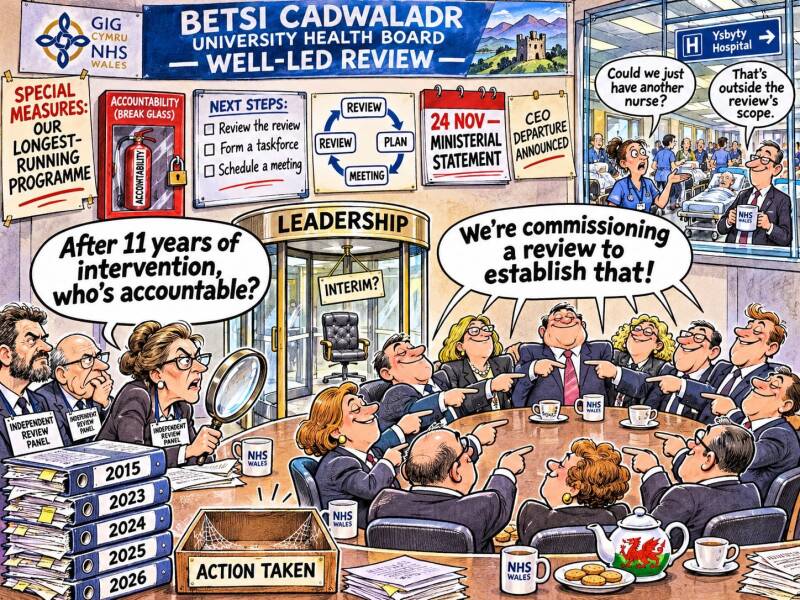
How many improvement plans does it take before somebody changes the method?
On 30 June 2026, the Welsh Government delivered perhaps the most ominous two words available to an organisation already accustomed to escalation, intervention, reviews and improvement plans:
“Final chance.”
Health and Care Minister Mabon ap Gwynfor announced a new and more direct intervention at Betsi Cadwaladr University Health Board.
There would be a full stocktake.
There would be an independent Well-Led Review.
There would be stronger independent challenge.
There would be evidence-based recommendations.
And Welsh Government said the intervention represented a move away from previous arrangements in which the Health Board largely led its own recovery with external support, because that approach had not delivered change at the required pace or scale. [6][7]
Strong words.
But Betsi Cadwaladr and strong words have met before.
Quite a few times, actually.
Before the final chance came several previous chances
The current story did not begin in 2026.
Nor did it begin when Betsi Cadwaladr returned to special measures in February 2023.
The formal escalation history stretches back more than a decade.
The Health Board was placed in enhanced monitoring in December 2013, moved to targeted intervention in November 2014 and, in June 2015, entered special measures. The concerns recorded across that period included mental health services, finance, performance, maternity services, GP out-of-hours services, governance, leadership and public engagement. [1]
Special measures, naturally, produced plans.
There were improvement programmes.
There were external advisers.
There were strategies to develop.
There were governance arrangements to strengthen.
There were services to improve.
There were milestones to achieve.
There were mechanisms to demonstrate progress.
NHS organisations do not suffer from a shortage of nouns.
Betsi remained in special measures until 24 November 2020, when Welsh Government formally de-escalated it to targeted intervention after taking advice following a meeting involving the Chief Executive of NHS Wales, Healthcare Inspectorate Wales and Audit Wales. Welsh Government said improvements had been made and that it had greater confidence further progress would follow. [2]
That formal decision matters.
But so does the date.
The 2020–2023 gap was not ordinary time
November 2020 was not an ordinary point in the history of the NHS.
It fell in the middle of the Covid-19 pandemic.
Hospitals were operating under extraordinary pressure. Normal elective activity had been severely disrupted. Staffing, sickness absence, infection control, patient flow, visiting, discharge arrangements and service priorities had all been transformed.
Performance measures that might ordinarily help us judge whether an organisation was functioning sustainably were themselves being distorted by a national emergency.
Betsi therefore did leave formal special measures in November 2020.
But it did not leave intervention. Targeted intervention remained a heightened level of escalation. [2]
And it entered perhaps the least suitable period imaginable for testing whether normal organisational recovery had genuinely taken hold.
The years between 2020 and 2023 should therefore not simply be read as:
Betsi improved, left special measures, remained stable for three years, and then deteriorated again.
The historical reality is messier.
Those years sit inside an exceptional period whose effects on healthcare governance, workforce pressures, patient safety, service delivery and decision-making are still being examined through national reviews and inquiries.
The UK Covid-19 Inquiry examined the pandemic’s impact on healthcare systems across all four UK nations. Its Module 3 report on healthcare systems was published on 19 March 2026, and the Welsh Government published its formal response on 17 September 2026. [14][15]
Then, on 3 November 2026, Welsh Government announced a separate Independent Wales Covid-19 Review, chaired by Professor Daniel Wincott of Cardiff University. The review is intended to complement the UK Inquiry, focus particularly on health and adult social care, assess whether lessons and recommendations have actually been implemented, identify gaps in the evidence and report publicly in stages. It is expected to conclude by March 2029. [16]
In other words, the apparent break between Betsi’s two periods of special measures occupies a historical period that is itself still being investigated.
That does not mean the 2020 decision to de-escalate Betsi was wrong.
Nor does it mean no improvement occurred.
It simply means that treating 2020–2023 as a clean demonstration of sustained organisational recovery would require rather more confidence than the historical circumstances justify.
The Health Board had left special measures.
It had not left intervention.
And it had entered the most abnormal period the NHS had experienced in generations.
Then came 2023
On 27 February 2023, Betsi Cadwaladr returned to special measures, at level 5, the highest level of NHS escalation.
Welsh Government recorded serious concerns about Board effectiveness, organisational culture, service quality and reconfiguration, governance, patient safety, operational delivery, leadership and financial management. The Chair, Vice-Chair and independent members of the Board stepped aside. [3][4]
Once again, a framework appeared.
It identified broad areas requiring improvement including governance and Board effectiveness, workforce and organisational development, financial governance and management, compassionate leadership and culture, clinical governance and patient safety, operational delivery, planning and service transformation, and clinical services. [4]
And once again, there were plans.
There were action plans.
There were quarterly reports.
There were oversight meetings.
There were independent advisers.
There were governance reviews.
There were assessments.
There were improvement priorities.
There were de-escalation criteria.
There were reviews of the reviews.
If the NHS ever develops a national shortage of improvement frameworks, north Wales may have some spares.
This is not to suggest that nothing improved.
Welsh Government’s March 2026 progress report said the Board had consolidated governance and leadership reforms and progressed its quality and safety systems. It also recorded strengthened corporate assurance, clearer risk and performance frameworks and improvements in financial governance. [5]
But improvement did not equal resolution.
The same report recorded significant and persistent challenges in delivering safe, timely and effective care, particularly in cancer, planned care and urgent and emergency care. [5]
By this point Betsi Cadwaladr had spent the period since December 2013 continuously within some form of heightened NHS escalation arrangement: enhanced monitoring, targeted intervention or special measures. [1]
The labels had changed.
The plans had changed.
The leadership had changed.
The problems had changed in emphasis.
But intervention remained.
Then Welsh Government changed the method
Which brings us back to June 2026.
This time, Welsh Government explicitly acknowledged something rather important.
Previous approaches had relied on the Health Board leading its own recovery with external support.
That approach, Welsh Government said, had not produced the pace or scale of change required. [6]
So Welsh Government would take a more direct role.
That distinction matters.
For years, Betsi had been expected to develop plans, respond to reviews, implement recommendations, provide assurance and demonstrate improvement while receiving varying levels of external support and oversight.
The 2026 intervention represented a change in emphasis.
Welsh Government was no longer simply asking:
“What is your improvement plan?”
It was commissioning an independent assessment of the organisation itself.
The review would examine leadership, governance and organisational culture; quality, safety and patient experience; Board and executive capacity and capability; and areas of good practice. A nationally appointed expert panel would provide evidence-based recommendations. Monthly interim findings were also expected to inform the ongoing intervention. [7]
And the timetable was unusually clear.
The final Well-Led Review report was expected to be submitted to Welsh Government by the end of October 2026. [7]
An independent panel arrives
On 11 August, Betsi Cadwaladr announced the panel.
It would be chaired by Dr Kathy McLean, supported by Professor Sir Stephen Powis, Dame Alwen Williams, Professor Em Wilkinson-Brice and Dr Pamela Johnston. [8]
The Health Board described the review as examining its strategy, culture, leadership, governance and accountability arrangements. A separate Welsh Expert Reference Panel would provide advice and context concerning NHS Wales policy, governance and regulation. [8]
Chief Executive Carol Shillabeer said the Health Board would engage openly with the review and act on its findings. Chair Dyfed Edwards said independent scrutiny was an important part of good governance. [8]
This was therefore not simply another internal improvement plan.
It was an externally led assessment commissioned because previous arrangements had not delivered sufficient change.
And both Welsh Government and the Health Board were publicly pointing to the end of October for the final report. [6][7][8]
October came
September first provided a slight change in language.
Giving evidence to the Senedd Health and Social Care Committee on 17 September 2026, the Health Minister said the Well-Led Review remained ongoing and would be fed back “by the early winter”. [9]
Perhaps that was merely a broader description of the same timetable.
Then October came.
October went.
On 3 November, First Minister Rhun ap Iorwerth told the Senedd that the independent review was expected to be submitted to Welsh Government imminently so that the Government could move forward. [10]
That wording matters.
Not published imminently.
Not discussed imminently.
Submitted imminently.
The original timetable had been for the final report to be submitted by the end of October. [7]
Then came 11 November
On 11 November, responding to questions in the Senedd about Betsi Cadwaladr, Health and Care Minister Mabon ap Gwynfor gave the next piece of the chronology.
He said the Well-Led Review was expected to be published imminently. He also said he would make a statement in the Senedd on 24 November based on the review, after which decisions would be made about the next steps for Betsi Cadwaladr. [11]
That does not establish 24 November as the publication date of the report itself.
But it does place a rather conspicuous marker in the calendar.
The Senedd’s published business schedule now lists a 45-minute statement for 24 November titled: “Update on Level 5 intervention and Welsh Government response to the Betsi Cadwaladr UHB Independent well-led review.” [12]
Two days later, on 26 November, Betsi Cadwaladr is scheduled to hold its next public Health Board meeting at Venue Cymru in Llandudno. [13]
As of 14 November 2026, I can find no publicly released final Well-Led Review report on the official Welsh Government, Senedd or Betsi Cadwaladr websites.
That does not prove failure.
It does not mean the report has been suppressed.
It does not establish that the panel has done anything improper.
Perhaps additional evidence was required.
Perhaps factual checking took longer.
Perhaps the scope developed.
Perhaps the panel and Welsh Government agreed that additional time was justified.
Perhaps the report is complete and moving through publication processes.
All are perfectly plausible explanations.
But they remain possibilities because the public explanation for the movement from the end-of-October submission date has not, so far, been clearly set out.
Which produces a very ordinary question:
What is the current reporting timetable?
Why should a few days matter?
On their own, perhaps they do not.
Independent reviews of major NHS organisations should not be rushed simply to satisfy an arbitrary date.
A useful report delivered slightly later is plainly preferable to a superficial report delivered punctually.
But context matters.
This review was not commissioned as routine governance housekeeping.
It followed more than a decade of heightened escalation.
It followed two periods of special measures separated by targeted intervention and the extraordinary Covid era.
It followed years of improvement plans, progress reports, independent advisers and formal oversight.
And Welsh Government explicitly said it was changing approach because previous Health Board-led recovery arrangements had not delivered improvement at sufficient pace or scale. [6]
The latest intervention promised stronger external challenge and greater accountability.
When those are the circumstances used to justify a new intervention, transparency about the intervention’s own progress becomes part of the accountability story.
There are therefore several perfectly reasonable questions.
Was the review completed by the end of October?
When was the final report submitted to Welsh Government?
Were the expected monthly interim findings provided during the review?
Was the timetable formally extended?
If it was, when and why?
What happens to the report after submission?
And perhaps most importantly for patients, staff and communities across north Wales:
When will the final report become public?
None of those questions presume wrongdoing.
They simply follow the commitments already made.
Reviews of reviews of improvement plans
Betsi Cadwaladr has not lacked scrutiny.
Nor has it lacked plans.
Over more than a decade it has experienced enhanced monitoring, targeted intervention, special measures, de-escalation, re-escalation, improvement frameworks, action plans, strategic plans, independent reviews, external advisers, ministerial oversight, quarterly progress reports and Board assurance processes. [1][4][5]
Even the strange 2020–2023 interval cannot simply be filed away as a quiet period of normality.
Those years belong to a global pandemic whose impact on the NHS is still being examined by the UK Covid-19 Inquiry and now by a dedicated independent Welsh review. [14][15][16]
There has been genuine progress during Betsi’s long history of intervention.
There have also been recurring concerns involving leadership, governance, organisational culture, planning, performance and patient safety. [1][3][5]
The interesting question in 2026 is therefore no longer whether another plan can be written.
NHS organisations are exceptionally good at producing plans.
The question is whether this latest intervention produces something different:
clear findings,
clear responsibility,
clear actions,
clear timescales,
and publicly visible evidence that those actions result in sustainable change.
Welsh Government itself recognised in June that the previous model had not delivered improvement at the required pace or scale. [6]
That is precisely why the independent panel matters.
And it is precisely why its eventual report deserves close attention.
Final chance
There is something unusually powerful about describing an intervention as a final chance.
It creates urgency.
It establishes expectations.
It tells patients, staff and the public that this time something materially different is intended.
But “final chance” cannot merely become another phrase in the historical archive beside:
special measures
targeted intervention
improvement framework
action plan
progress report
and
independent review.
Eventually the language has to connect with measurable change.
The independent panel may yet provide exactly the challenge required.
Its findings may explain why improvements have proved difficult to sustain.
Its recommendations may provide a clearer route forward.
Welsh Government may act decisively upon them.
The Health Board may respond effectively.
At present, we simply do not know.
We are waiting for the report.
That, by itself, is not a scandal.
But when an organisation has spent more than a decade moving through escalating interventions, and when the latest intervention was introduced because previous arrangements had not worked quickly enough, movement beyond a publicly announced reporting milestone deserves explanation.
Perhaps the explanation will be entirely mundane.
Most organisational mysteries eventually are.
But the first test of transparent accountability is surprisingly simple:
Tell people what is happening.
Betsi Cadwaladr has been given its “final chance”. [6]
The independent panel has been asked to assess what needs to change.
The original end-of-October submission milestone has passed.
On 3 November, submission was described as imminent. [10]
On 11 November, publication was described as imminent. [11]
A Welsh Government response to the review is scheduled for 24 November. [12]
The Health Board meets publicly on 26 November. [13]
And before we debate what the report eventually says, there is one considerably simpler question.
Where are we with the report?
Sources and verified links
All links below were checked against official sources on 14 November 2026.
[4] Welsh Government — Betsi Cadwaladr University Health Board special measures: year 1 progress report
[6] Welsh Government — Welsh Government action to transform north Wales health board, 30 June 2026
[8] Betsi Cadwaladr UHB — Well-led Independent Review and NHSW PI support, 11 August 2026
[9] Senedd Record — Health and Social Care Committee, 17 September 2026
[10] Senedd Record — Plenary, 3 November 2026
[11] Senedd Record — Plenary, 11 November 2026
[13] Betsi Cadwaladr UHB — Health Board meetings: 26 November 2026 public Board meeting
[14] Welsh Government — Written Statement: UK Covid-19 Inquiry Module 3 Report, 19 March 2026
[15] Welsh Government — Response to UK Covid-19 Inquiry Module 3 report, 17 September 2026
Create Your Own Website With Webador